The Solar Boats of Khufu: A Journey Through the Afterlife and Modern Museology
The solar boats of Pharaoh Khufu, discovered at the foot of the Great Pyramid of Giza, are profound testaments to the intricate beliefs and advanced craftsmanship of ancient Egypt. For decades, the first of these 4,600-year-old vessels was housed in a dedicated museum on the Giza plateau, offering a glimpse into the pharaoh's journey to the afterlife. Now relocated to the Grand Egyptian Museum (GEM), these artifacts continue to unveil the secrets of their time, from sophisticated engineering to the complex solar theology that underpinned the Egyptian concept of eternal life. The daily journey of the sun god Ra was a cornerstone of this belief system, providing a divine blueprint for the pharaoh's own resurrection.
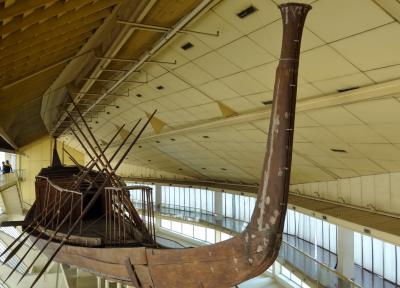
The Great Debate: Ritualistic Barge or Practical Vessel?
The precise purpose of Khufu's solar boats remains a topic of lively scholarly discussion, with compelling evidence supporting both ritualistic and practical functions.
The Ritualistic Theory: A Celestial Voyage: The prevailing interpretation is that the boats were primarily ritualistic "solar barques" intended for the Pharaoh's use in the afterlife. According to ancient Egyptian solar theology, the deceased king, considered the earthly manifestation of Ra, would join the sun god on his eternal journey to ensure his own rebirth. This celestial cycle involved two distinct vessels:
- The Mandjet (Day Boat): Each dawn, Ra was reborn and would board his day barque, the Mandjet or "Boat of Millions of Years," to sail across the sky, bringing light and life to the world. During this passage, he would transform from the youthful scarab beetle god Khepri at sunrise, to the supreme, falcon-headed Ra at his zenith, and finally to the aged man Atum at sunset.
- The Mesektet (Night Boat): At dusk, Ra would enter the perilous underworld, known as the Duat, and transfer to his night barque, the Mesektet. In a ram-headed form, he would navigate the twelve hazardous regions of the Duat, bringing temporary light to the souls of the justified dead. The greatest threat was the nightly battle against his arch-nemesis, the great serpent Apep, the embodiment of chaos (isfet). Aided by a divine crew including gods like Set, Ra's victory over Apep was essential for the sun to rise again, representing the triumph of cosmic order (Ma'at) over chaos.
- By burying these vessels in sealed pits, Khufu ensured he had the necessary transport for this celestial voyage, allowing him to join Ra, overcome the chaos of the underworld, and achieve daily resurrection.
The Practical Use Theory: In contrast, some scholars argue the boats served a practical purpose before being interred. Evidence of wear on the wood suggests the first boat had been in water. This has led to hypotheses that it was used as a funerary barge to transport the pharaoh's embalmed body from Memphis to his final resting place at Giza, or for pilgrimages to sacred sites during his reign.
A Combined Purpose: These two theories are not mutually exclusive. It is plausible that the boat served a practical function in the pharaoh's funeral procession before being ritually "decommissioned" and buried for its eternal, symbolic role in the afterlife.
Visite: Amazing Egypt Tour From Toronto
Discovery and Reconstruction
A Serendipitous Discovery
In May 1954, a historic discovery was made during a routine cleaning operation on the south side of the Great Pyramid. Egyptian archaeologist Kamal el-Mallakh was supervising the removal of debris for a new tourist road when he acted on a hunch about a limestone wall that seemed unusually close to the pyramid. His team dug down and uncovered a row of 40 massive limestone blocks. On May 26, 1954, a hole was drilled through one of the blocks, releasing the distinct scent of ancient cedar wood. Peering inside with a mirror to reflect sunlight, el-Mallakh saw the perfectly preserved and methodically disassembled pieces of a full-sized boat, complete with oars and ropes, that had been sealed for over 4,500 years. The find was hailed as one of the most significant in Egyptian archaeology since the discovery of Tutankhamun's tomb.
The Decade-Long Puzzle
The monumental task of reassembling the vessel fell to Ahmed Youssef Moustafa, the chief restorer for the Egyptian Department of Antiquities. The boat was found in 1,224 individual pieces, laid out in a logical order within the pit. However, with no instructions, the reconstruction was a formidable puzzle that took over a decade to solve.
- Intensive Research: Moustafa first had to embark on extensive research into ancient shipbuilding. He meticulously studied reliefs on tomb walls and wooden boat models found in other tombs to understand their design. He also visited traditional boatyards in Old Cairo, Maadi, and Alexandria to see if ancient techniques had been passed down through generations.
- Mastering Ancient Techniques: A primary challenge was understanding the "shell-first" construction method, where the outer hull was built before the internal frame. The planks of Lebanese cedar were shaped and fitted together using unpegged mortise-and-tenon joints and then "stitched" together with ropes made of Halfa grass. This ingenious technique allowed the wood to swell in water, tightening the ropes and making the vessel waterproof without a single metal nail. Moustafa and his team had to painstakingly document, preserve, and reassemble each fragile piece, a process requiring immense patience and skill.
Masterpieces of Ancient Engineering
The reassembled Khufu ship is a marvel of ancient craftsmanship, showcasing the advanced woodworking skills of the Old Kingdom.
- Dimensions: The boat measures approximately 43.4 meters (142 feet) in length and 5.9 meters (19 feet) in width.
- Materials: It is constructed primarily from imported Lebanese cedar wood, with some Egyptian acacia.
- Construction: The vessel was built using a "shell-first" method, where the outer hull planks were assembled before the internal frame. Planks were fitted together with mortise-and-tenon joints and lashed together with ropes made of Halfah grass, with no metal nails used in the original construction.
From Giza to GEM: A Tale of Two Museums
The Original Giza Solar Boat Museum: A Controversial Home
In 1982, the Giza Solar Boat Museum was built directly over the pit where the vessel was discovered. The design was primarily utilitarian-a rectangular building of reinforced concrete and steel with multiple viewing levels-focused on protecting the fragile artifact with climate control. However, the museum was widely criticized for its aesthetics and functionality.
- Architectural Intrusion: Many considered it an "aesthetic disaster" and an "eyesore" that marred the scenic view of the Great Pyramid, the last remaining wonder of the ancient world. One critic unfavorably compared its appearance to a "rundown warehouse".
- Outdated Technology: The museum lacked the modern technological equipment needed for the optimal long-term preservation of the delicate wood. There were also concerns that water seepage from the museum's construction may have damaged the second, still-buried boat pit.
- Poor Visitor Experience: Its display methods were considered outdated, and it was not equipped with adequate accessibility for visitors with disabilities. These factors ultimately led to the decision to relocate the priceless vessel.
A Monumental Relocation to the Grand Egyptian Museum
In August 2021, the 4,600-year-old, 20-ton solar boat was moved in a monumental feat of modern engineering to its new home at the Grand Egyptian Museum. The transfer was the culmination of nearly a year of intensive planning and international collaboration.
A Collaborative Effort: The ambitious project was overseen by the Egyptian Ministry of Tourism and Antiquities. It involved a consortium of experts, including the Grand Egyptian Museum, the Supreme Council of Antiquities, and Cairo University's Faculty of Engineering. The physical move was managed by the BESIX-Orascom Construction Joint Venture, with heavy-lifting and transport specialist Sarens handling the intricate operation.
Meticulous Preparations: The decision was made in 2019 to move the boat as a single, intact piece, a prospect considered safer than dismantling the fragile artifact. Preparations included laser scanning the boat for documentation, conducting radar surveys of the route to ensure stability, and running multiple simulations of the journey with identical weights and dimensions. To protect the vessel, a custom-made 60-tonne steel cage was built to encase it, bringing the total transport weight to 100 tonnes.
The Specialized Vehicle: At the heart of the operation was a Self-Propelled Modular Transporter (SPMT) imported from Belgium. This remote-controlled "smart vehicle" was equipped with advanced technology to absorb vibrations and adapt to terrain changes, crucial for protecting the ancient wood. Its design allowed it to navigate sharp turns and slopes, essential for maneuvering through the archaeologically sensitive Giza plateau.
A Three-Day Chronological Journey: The transfer unfolded over three days in early August 2021.
- Day 1 (August 5): The operation began with the delicate extraction of the boat from its old museum. The SPMT navigated into the building with only 20 centimeters of clearance on each side, contending with strong winds on the plateau to lift the boat and secure it in its protective cage.
- Day 2 (August 6): The convoy began its 7.5 to 8.5-kilometer journey late in the evening. Traveling at a painstaking speed of just 1 kilometer per hour, the remote-controlled vehicle took approximately 10 hours to navigate a carefully selected route, proceeding through the night to minimize disruption.
- Day 3 (August 7): Upon arriving at the GEM, an 800-tonne crawler crane lifted the 100-tonne caged boat to a height of 30 meters. It was then lowered with centimeter accuracy through a specially designed opening in the roof of its new, dedicated building.
A New Era at the Grand Egyptian Museum
The First Boat's State-of-the-Art Exhibition
The first Khufu boat is now the centerpiece of a new, purpose-built building on the GEM campus, designed to provide a secure, "world-class museum experience". This state-of-the-art facility is equipped with cutting-edge technology for long-term preservation and an enhanced visitor experience.
- Advanced Preservation: The building features the latest scientific systems for museum display, including advanced climate, humidity, and lighting controls to ensure the boat's safety.
- Immersive Curation: The curatorial approach aims to deepen the visitor's understanding of the boat's historical and religious significance. Immersive and interactive displays will explain ancient shipbuilding techniques and the boat's symbolic role in the pharaoh's celestial journey with Ra, with funerary texts like the Book of the Dead and the Amduat serving as guides for this voyage.
The Second Boat: A Live Window into the Past
The second solar boat, which remained sealed in its pit, is the focus of a groundbreaking restoration project that forms a key part of the new museum's curatorial strategy.
- Excavation and Discovery: A joint Egyptian-Japanese team began excavating the second pit in 2011, finding the boat in a poorer state of preservation due to moisture. The team extracted approximately 1,700 wooden pieces from 13 layers, a process completed in 2021. This study revealed the oldest known use of metal hooks in Egyptian boat construction, a significant technological discovery.
- Public Restoration: In a unique approach supported by the Japan International Cooperation Agency (JICA), the restoration is being conducted in full view of museum visitors at the GEM. This "live" reconstruction offers a rare and dynamic educational opportunity, allowing the public to witness the science of conservation firsthand and gain a deeper appreciation for the skill of both ancient and modern craftspeople. The project is expected to take several years, after which the second boat will be displayed alongside the first.
Summary
The Solar Boats of King Khufu are 4,600-year-old vessels that offer a profound glimpse into ancient Egyptian beliefs about the afterlife. Their purpose is debated, but the prevailing theory is that they were ritualistic "solar barques" for the pharaoh's celestial journey with the sun god Ra. This voyage was central to Egyptian theology, involving a day trip on the Mandjet boat and a perilous nightly journey through the underworld (the Duat) on the Mesektet boat, where Ra had to defeat the chaos serpent Apep to rise again. By joining this cycle, the pharaoh could achieve his own resurrection.
The first boat was discovered in 1954 by archaeologist Kamal el-Mallakh near the Great Pyramid. Found disassembled into 1,224 pieces, it was meticulously reconstructed over a decade by chief restorer Ahmed Youssef Moustafa. For decades, it was housed in a museum on the Giza plateau that was widely criticized for its intrusive architecture and outdated technology that could not ensure the artifact's preservation.
In August 2021, this 20-ton masterpiece was moved in a monumental, three-day feat of engineering to a new, dedicated building at the Grand Egyptian Museum (GEM). The transfer, a collaboration of Egyptian authorities and international specialists, involved placing the vessel in a protective steel cage and transporting it overnight on a remote-controlled vehicle imported from Belgium. The new state-of-the-art facility ensures its long-term preservation and uses immersive displays to explain its historical context. A second boat, found in a more deteriorated condition, is currently undergoing a multi-year restoration in full public view at the GEM, a project that has already revealed new insights into ancient technology. The display of both boats at the GEM will offer an unprecedented look into the craftsmanship and religious world of the Old Kingdom.